This is an early version of the entry in Wikipedia I have made about the village in which I live. The most up-to-date version (although not guaranteed to have been all my own work) can be found at: http://en.wikipedia.org/wiki/High_Shincliffe
High Shincliffe
Geography
High Shincliffe is a village in County Durham, in north-eastern England. It is situated a few miles south-east of Durham City, on the road (A177) to the village of Bowburn. The altitude of High Shincliffe is aproximately 100 metres (300 feet), and it lies 60 metres above the River Wear at Shincliffe bridge. The grid reference is NZ297400, 54° 45' 17" N, 1° 32' 15" W.High Shincliffe is often thought of as being part of Shincliffe, although the terms Shincliffe Village and High Shincliffe are also often used to distinguish the two. The place name sign on the A177 northbound through High Shincliffe reads 'Shincliffe'.Ecclesiastically, High Shincliffe is the the Anglican parish of Shincliffe, in the Anglican diocese of Durham. There is no church in High Shincliffe. The parish church of St. Mary is located in Shincliffe Village, where there is also a graveyard in which burials still take place. There was once a chapel in Shincliffe Colliery, remembered in the name given to the location of two houses built on the site: Chapel Place.Politically, High Shincliffe is part of the District of Durham (i.e. Durham City), which has both a City Council and an historic mayor. High Shincliffe is also in the Durham City parliamentary constituency. Unilke both the parliamentary seat (Roberta Blackman Woods, Labour) and County Durham, with its overwhelming Labour majority, the City of Durham is administered by the Liberal Democrats. The political demography of High Shincliffe probably epitomises that liberal ethos.High Shincliffe is best characterised as a dormitory suburb of Durham City, to which the inhabitants of High Shincliffe mostly look for shopping, services and entertainment. However, there is a small, well-regarded primary school, a recreational park with equipment for young children, a popular pub ('The Avenue'), a public telephone box and several bus stops. As in Shincliffe Village, there used to be a sub Post Office in High Shincliffe, close to the site of the large red letter box at Bank Top. High Shincliffe sub Post Office also served as a small general store. The nearest sub Post Office and nearest grocery stores are in the village of Bowburn, approximately a mile to the south of High Shincliffe. The nearest public lending library is also in the village of Bowburn, although the new Clayport Library in the centre of Durham City is considerably superior both in its range of books and its facilities. There used to be a public house close to Bank Top, at the junction between Avenue Street and Whitwell Acres, and a large 'Y', being the initial for Young's brewery, can still be seen in the domestic house that stands on the corner. The only public house in High Shincliffe now is The Avenue, on Avenue Street.The A177 from Durham to Bowburn, via High Shincliffe, has been partly laid out as a cycle route. High Shincliffe is served by serveral bus routes, some to local villages, and others ranging more regionally. The buses are popular, but car ownership in High Shincliffe is high, not least because most supermarket shopping is located on out-of-town sites about five miles, and a second bus journey, away (Sainsbury's and Lidl at the Arnison Centre; Tesco and Aldi in Gilesgate Moor / Dragonville). The nearest railway station is about three miles away in Durham, on the East Coast Main Line between London and Edinburgh. (The next major station to the north is Newcastle (16 minutes), and to the south is Darlington (20 minutes)). When the air is still it is possible to hear traffic on the East Coast Main Line through Hett Cut. Sometimes, in the dead of night, heavy goods trains on the East Coast Main Line cause vibrations to travel through the ground, gently shaking the houses of High Shincliffe as though a barely detectable earthquake. There are two airports, both roughly equidistant, within easy reach of High Shincliffe. To the north is Newcastle International Airport, the major of the two airports; to the south is Durham Tees Valley Airport (formerly Teesside Airport). High Shincliffe is usually on the flight path into Newcastle Airport for air traffic from or via southern England. High Shincliffe is within a mile of the A1(M) motorway from London to Edinburgh, although the nearest motorway junction is two miles away, just beyond the village of Bowburn. Traffic on the motorway, although not loud, is frequently audible. In summary, High Shincliffe can be thought of as well-located for convenience of travelling locally, regionally, nationally and internationally.
History
The A177 road running south-east from Durham is marked on Ordnance Survey maps as a Roman road: Cade's Road. This Roman road ran from Newcastle in the north, southwards through Chester-le-Street, crossed the River Wear at Shincliffe (Village), climbed Shincliffe Bank, ran straight through Bowburn and Coxhoe, passed the site of a deserted medieval village called Garmondsway, just south of Coxhoe, through to Sedgefield, crossed the River Tees at Piercebridge, and continued southwards eventually to the River Humber. During the nineteenth century the road running past Shincliffe Colliery was known as Turnpike Road. High Shincliffe was formerly known as Shincliffe Colliery, as shown on the Ordnance Survey map of 1856-1865. According to Durham Mining Museum, a shaft into a coal mine was first sunk here on 11 September 1837. Two years later the mine started to produce coal. By 1840 the colliery was in full production, mining a seam of coal (the Hutton seam) six feet (two metres) thick at a depth of 400 feet (120 metres), which was 100 feet (30 metres) below sea level. Most of the pre-twentieth century houses in High Shincliffe date from this period, including Quality Street. In total, 18 people were killed at the mine, the youngest being a girl aged nine years who strayed onto the waggonway and was crushed by some waggons. The mine was finally closed, considered exhausted, in 1875, from which time the population of the village declined substatially. This decline can be seen on the Ordnance Survey map of 1894-1899. The Ordnance Survey maps of 1919-1926, 1938-1950 and 1951-1959 show only a handful of rows of houses remaining. By the time of the 1960-1969 Ordnance Survey map there were even fewer houses, and the name Shincliffe Colliery was finally lost. The only cartographical indication that these dwellings were separate from Shincliffe (Village), is the retention of the name 'Bank Top' for the houses that clustered around the Post Office at the top of Shincliffe Bank ('bank' being the local name for a small hill up which a road climbs). However, due to changes at County Council level, the building of a major housing development and primary school was undertaken, the house-builders Leech being a significant contractor. (It is interesting to note that many of the new houses had heating oil pumped directly into their central heating systems from a central storage facility, and it is still possible to see the pipework as it enters a house. The system is unlikely to have been used for long as the price of heating oil rose steeply not long after the houses were completed, making the use of heating oil uneconomic.) The 1970-1979 Ordnance Survey map shows not only this substantial housing estate, but also a name change of the location to Shincliffe Bank Top. The ensuing Ordnance Survey map (1980-1994) shows some additions to this housing estate, but also a further name change to 'High Shincliffe'.Most evidence of the nineteenth century colliery has long vanished. However, some houses of the period remain, such as Quality Street, Pond Street and The Avenue. A few old walls can be found. The school is built on site of the pit-head, and the centre circle of the school's football pitch marks the spot where the coal mine shaft was sunk. A pit-heap remains, overgrown with birch trees, and is used by dog owners to toilet their pets. The line of the colliery waggon-way runs from the pit-head northwards past Manor Farm and on to Shincliffe Lane. This was the route that coal was originally transported from the mine, and thence to the coast where it was loaded onto colliers. South-east from the pit-head, however, a waggon-way was extended to what was once the main railway line from London to Edinburgh, the junction being named Shincliffe Station. This railway line, the Leamside Line, running from Ferryhill to the south, via Sherburn, to Washington, and thence to both Newcastle and to Sunderland (connecting with what is now the Tyne & Wear Metro at South Hylton), remained in occasional use until the early 1990s. Substantial subsidence has almost certainly undermined any plans to re-open the line.
Natural History
Much of High Shincliffe was built in the 1970s, consisting of detached and semi-detached single and two storey houses with gardens to front (mostly open plan) and rear. The estate has a tranquil atmosphere, with many tidily kept gardens, some trees, and a high density of both domestic cats and garden birds such as blue tits, great tits, coal tits, long-tailed tits, pied wagtails, yellow wagtails, chaffinches, green finches, yellow hammers, tree creepers, blackbirds, song thrushes, mistle thrushes, redwing, swallows, swifts, house martins (there are sand martins close by). A colony of collared doves lives somewhere near the school, as does a feral dark-feathered cockerel (named 'Rocky'). Occasioanl garden visitors are great spotted woodpeckers, little owls (there are barn owls close by) and sparrow hawks (there are kestrels close by). Bats are quite numerous during the warmer months, as are mice when the weather turns colder. Foxes rear their young close by, and it is sometimes possible to watch them playing in the fields as evening turns to night. Badgers and red deer live close by, but unlike the foxes are rarely if ever to be seen in the housing estate. Grey squirrels are becoming increasingly evident, but moles less so. Hedgehogs are common garden visitors, as are frogs. Toads and newts are less common, as are small sand-coloured lizards and slow worms.High Shincliffe is surrounded by farmland and farm houses supporting a mixture of crops (cereals and rapeseed) and livestock (cows and sheep). There are many brakes of mixed, largely deciduous woodland, and these are used as shelters to rear pheasants which are then shot for sport. There are no rivers in High Shincliffe, although the River Wear is only a mile away at Shincliffe bridge. Whitwell Beck rises in High Shincliffe, and may account for the prevalence of amphibian creatures. There are both footpaths and bridleways criss-crossing the fields.
Peter.
24 December 2006


18 December 2006
The night we got trapped in the Louvre
It was between Christmas and New Year a few years ago. We had driven to Paris for a short break. Not having visited the Louvre during our most recent trips to Paris, reacquainting ourselves with some of the works it houses seemed like a good idea. Like 'my father's house' the Louvre is a museum of many rooms, or galleries.
The evacuation alarm, a false alarm as it turned out, should have alerted us to a conspiracy of fates, the misalignment of celestial bodies, or some such like. La Giaconda wore her teasing smile inscrutably. Venus de Milo appeared disarmingly relaxed. We wandered through galleries, the walls of which were hung with priceless works of art from every age, some grand, some beautiful, and some thinly-disguised pornography.
It was while in a gallery carefully littered with Roman sarcophagi we learned that, although this was the day of late-evening opening, some of the galleries, including the one in which we were standing, would be closing early. Dutifully wending our way back to the elevator we found our route blocked by a locked door preventing entry to a now-closed gallery. Returning to the Roman sarcophagi, we found our route equally blocked by long, graceful flights of stone stairs, down which ambulant people were making their casual retreat. Gripping tightly the handles of Jemima's wheelchair, we asked a gallery attendant for guidance.
Far be it from me to call into question the cognitive intelligence of this, or any other gallery attendant, but it did appear that the man was unable to comprehend our problem. It was as though a cloak of invisibility had been thrown over Jemima and her wheelchair. He insisted on telling us that the gallery was now closed, and that we were make our way out. I think that it was our stubborn persistence that finally induced the puzzled Parisian to summon help - that or his fear that the situation could turn nasty. Slowly, like beads of perspiration on the forehead of the perplexed under pressure, more uniformed attendants began to appear. As the number of gallery attendants increased, over the ensuing half hour, to swell the knot of people in front of a particularly impressive Roman sarcophagus, the conclusion that galleries would have to be re-opened must have dawned. However, being December, dawn came both imperceptibly and late.
It would appear that everyday security arrangements for the Louvre involve the staff being organised into teams. Our problem, and that occupying by now more than a dozen gallery attendants, was that to exit the Roman gallery would involve not simply walking through galleries that had been locked, but passing through territory proprietorially-patrolled during the day by, and doors locked in the evening and unlocked in the morning by, other teams, the team members of which having since gone home for their evening meal, for leisure time devant la television, and anticipating a cup of cocoa to take to bed. To make matters worse, as the clock inexorably ticked ever later, further galleries were being put to bed for the night. Eventually, and it was an hour after the first attendant had puzzled over the issue, a proposed escape route from the labyrinth was mapped out and agreed, and keys were mysteriously acquired in order to unlock doors, to silence alarms and to operate elevators.
Melting into the darkness beyond the first locked door, we were entering a forbidden world. There was, about the experience, something of the passage through Moria by the Fellowship of the Ring. However, our Gandalf was possibly the least favoured of the attendants, and instead of a wooden staff he clutched several huge bunches of keys. We passed through door after door, walking in silence through gallery after gallery, watched by figures, real and imaginary, mundane and malign, from every century since the beginning of art. Masterpieces hung from walls unseen. Tapestries sheltered skulking assasins. Sculptures loomed from the gloom. A minotaur scuffed and scowled in the darkness, wishing to go about his unspeakable business unseen. We scurried past seductions and battles, holy families and still lifes, monarchs and madmen. Corridors, no longer now the arteries of daytime busyness, were subsiding into cold hard-heartedness. Underfoot would change from the softness of carpet to the creak of ancient floorboards to the echo of stone tiles. There was a smell of old wax polish, ancient, dusty furniture, and of resentment for the disturbance.
We arrived at the closed metal doors of an elevator shaft. It was the kind that springs to life only on insertion of a small, flat key. As in the depths of Moria, there was no light, and the hapless attendant could not see to select an appropriate key, of which there were many examples in his temporary possession. A torch would have been useful.
My cellphone has a flip, and it also has a large screen. Suddenly the soft glow of blue light, as though from the vial given to Frodo by Galadriel, was pushing back the orcs and goblins that had been advancing on us from all sides, and allowed the magic key to be identified. A mechanical hiccup was to be heard far off as though from deep underground. Hummings and whirrings approached. A clunk and a pause. Then, as the elevator doors slid open, we found ourselves snatched back to the twentieth century, standing in a pond of electric light.
There are tales of people spending the night, accidentally or otherwise, in the British Museum, although the veracity of these stories has to be in some doubt. It was disturbing to have been regressed through centuries of fantasy and reality as a result of the early closure of some galleries in the Louvre.
Peter.
01 December 2006
List for Santa Claus
Jemima has been using her Dynavox communication aid to write a long list of gifts she would like to receive as presents on Christmas day.
What about my list?
I find myself struggling to think of anything much that I desire as a gift. (Big issues here to explore in my own weblog!)
There are three movies that I watched once each at the cinema twenty or more years ago, and I should like to watch on DVD:
Steppenwolf, starring Max von Sydow
Kaos, directed by the Taviani brothers
Le Grand Meulnes
However, none of these movies has been released as a DVD in the UK. The impossibility of obtaining a copy of each is not the reason why I want them, but does explain why I do not already have them.
In terms of being convenient for my relatives, I have asked for DVDs of:
Balzac and the Little Chinese Seamstress
Spring, Summer, Autumn, Winter, Spring
I would ask for some Studio Ghibli anime DVDs, but we pretty much have the lot already. The same goes for DVDs (or VHS videos) of the works of Akira Kurosawa, Andrei Tarkovsky and Peter Greenaway. I have the three DVDs in the Koyaanisqatsi series (as well as a VHS video of Baraka - although I should prefer this in DVD as well). There are few Shakespeare movies that I do not have, and few Merchant-Ivory movies that I want and do not have. I have VHS videos of pretty much every Woody Allen movie there ever was. I have a substantial collection of British 'kitchen sink' VHS videos. We have a reasonable collection of movies from the French cinema, including Eric Rohmer (but mostly only copied from the television). Maybe, with a view to examining much more closely the process of making a French movie, I could concentrate on gathering a Rohmer DVD collection.
Dear Santa,
In order to help you choose what gifts to bring me, here are some ideas: ...
With best wishes,
Peter.
08 January 2006
The Lion, the Witch and the Wardrobe
I liked the film a lot because it's magical. Lucy hides in the spare room and sees the old wardrobe and jumps inside. She finds Narnia, it is a different country. There are talking animals, beavers and Aslan the lion. There are mythological animals like Mr. Tumnus the faun, unicorns and centaurs. Aslan wants to help Lucy and her brothers and sister and the animals defeat the White Witch. She's evil but beautiful. She makes it always winter but never Christmas, and changes animals into stone.
I like the story, I think it's exciting. I really like Lucy, she's sweet and Georgie Henley is a good actor. I like Peter and Susan and Edmund too, and I love Mr. Tumnus and the animals. They defeat the witch in a huge battle and the four children are crowned kings and queens on the thrones at Cair Paraval Castle.
I can't wait to see the next film about Narnia.
Jemima
Our holiday in France

I had a good holiday in France. I liked Disneyland, I saw things from different Disney films. I met Brother Bear, Jessie from Toy Story 2, Lilo and Mickey Mouse. I got autographs and photos. I saw shows with Mickey and Donald Duck, and with Lilo and Stitch. Daddy liked the car stunt show. I love Sleeping Beauty’s castle.
I liked the hotel in Toulouse. It was next to a big square with cafes. I liked Carcassonne, it is like in my game with walls and towers round the old city, I thought it was like a fairy tale.
In Paris I went up the Eiffel Tower and shopping with Mummy. I got stripey trousers and a pink jumper and a tee shirt. I felt happy back in Paris.
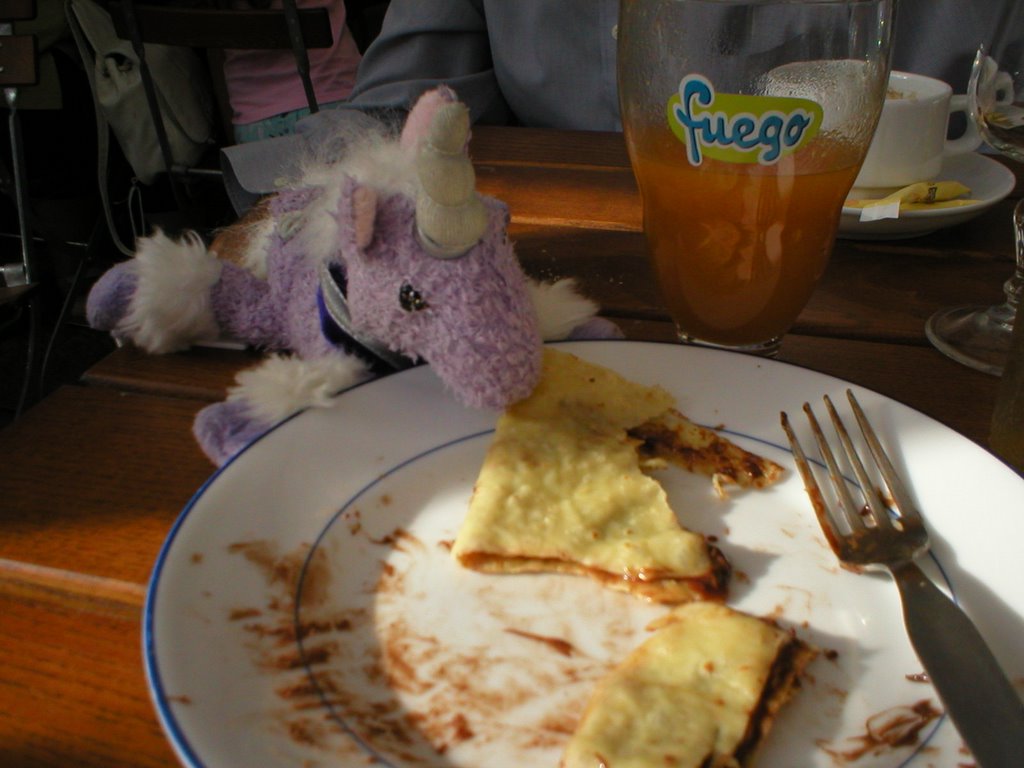
I like French food. I ate chocolate eclairs and croissants and pancakes. I spoke a little bit of French. I said, “Bonjour” and “merci” and “Je voudrais un crepe au chocolat” and “Je m’appelle Jemima”.
Jemima, written September 2005
08 December 2005
Jemima's Cool Yule: a second short movie
At the beginning of November 2005, Andrew Jeffrey (see previous posting) at the BBC asked if we would be willing to make a second short movie, focused on Jemima's expectations of, and preparations for, Christmas. Jemima was utterly thrilled at the prospect. As well as enjoying the mechanics of filming, and all the antecedent preparations, Jemima was ecstatic that a Christmas tree and decorations should be brought down from storage in the loft. Whilst maybe not the first house to be decked out for Christmas, it was easily a record for us!
The movie can be found online at
http://www.bbc.co.uk/tyne/videonation/index.shtml
and can also be viewed as the 'gift' in Day 7 of the CBBC advent calendar!
It was stimulating and exciting to work to a tighter deadline than with the first movie, and very satisfying to be able to build on what we had learned from making the first movie. There are still many aspects to improve, both in terms of quality and efficiency, and I look forward to further movie projects and new challenges.
My gratitude to Andrew Jeffrey is great. At the risk of embarassing him, he is a huge inspiration.
Peter.
04 August 2005
Jemima's BBC Video Nation short film
Jemima's first short movie for the BBC Video Nation project is online at:
http://www.bbc.co.uk/tyne/videonation/stories/jemima.shtml
The movie offers a peep-hole through which to glimpse a few aspects of Jemima's life, and shows something of how she creates her text that is uploaded here.
The film was edited by Andrew Jeffrey, a producer at the BBC in Newcastle. Andrew also offered guidance, gave encouragement, shot some of the film at Jemima's school, provided a stock photograph of Alan Shearer, obtained relevant permissions, and wrote the online text. He was a pleasure for which we are grateful.
07 June 2005
My wish
J umping on the trampoline,
E xcited about Disneyland,
M agic holiday, Magic Kingdom.
I wish I could fly there,
M y wheelchair whizzing
A cross the sky to France.
Jemima
E xcited about Disneyland,
M agic holiday, Magic Kingdom.
I wish I could fly there,
M y wheelchair whizzing
A cross the sky to France.
Jemima
14 May 2005

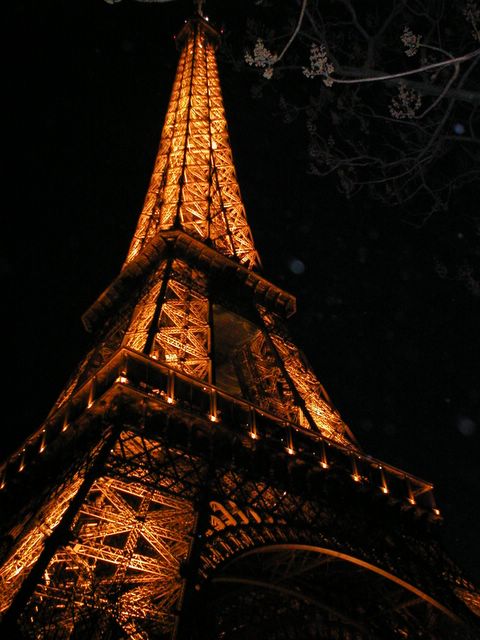
This photograph of the Eiffel Tower is about modern icons in the classical sense: the icon representing both a shorthand and also a memory prompt for a category of experiences. I guess that classical icons work on both public and private levels. The Statue of Liberty in New York City is equally iconic, albeit regarding a different set of experiences. The clock tower (housing Big Ben) in the Palace of Westminster 'stands for' London (as a tourist destination and cultural capital), the UK government (both as a seat of democracy, and as a repository of power with colonial resonances and domination over provincial UK), Britain as a tourist destination. In the UK, the Millennium Wheel (London Eye) is gradually achieving iconic status, and its recreational nature will carry the weight of tourist meaning more easily than 'Big Ben'. How iconic is The Angel of the North?


07 May 2005
Spring in the garden
Butter yellow daffodils, the neat, prim ones with the short, orange trumpets and no frills, prove that January is not too late to plant bulbs. Bluebells mass under the apple tree, and the vetetable patch is a jungle of forget-me-knots around the burgeoning rhubarb. Primroses spill onto the lawn, tulips stand proud if a little blowsy, and the kerria, Moth's shrub chosen years back by Jemima for our tabby's grave and in her memory, is heavy with vivid yellow pompoms. Plum blossom has come and gone in a shower of petals, but the apple tree has tightly clenched buds the colour of crushed raspberry and the conical, lime green rhododendron buds are starting to show a hint of lilac frill. Lest economy of truth paint too idyllic a picture, we should include the ankle high lawn ablaze with dandelions, across which the rambling rose is rambling rampantly in the absence of an arch. A week ago, everything was suddenly green; now it is lush.
The vivid orange flowers of the thorny berberis outside our bedroom window, more small tree than shrub, conceal a long tailed tits' nest crafted from twigs and grass and covered in grey lichen, teardrop shaped with a small hole through which I glimpsed the eye and beak of the incubating parent. The long tailed tits are perhaps our prettiest garden birds with their rapid, flitting movements, bobbing tails and pink tinged black and white plumage. Today I saw a fledgeling jump upwards from a branch, flap madly, then glide down to the lawn and return home in a series of semi-airborn hops. In April Jemima and I were fascinated at breakfast to watch a thrush constructing a deep, open-topped nest in the ivy which clothes the house wall outside our patio door; she laid a clutch of turquoise blue eggs speckled with brown, and sat calmly on them as I trotted in and out with baskets of laundry; but a fortnight ago she disappeared, perhaps frightened away by the evil tortoiseshell Shadow's attempts to climb the ivy. Jemima wept and wanted to save the unhatched baby birds, reluctant to accept that there was nothing we could do for the cold, abandonned eggs. The nut and seed feeders in the trees and the hanging bird table attract many small birds : blue and great tits, greenfinches, chaffinches and the occasional goldfinch, sparrows and robins. Blackbirds, starlings, magpies and collared doves are constant visitors, if not residents; woodpeckers alight occasionally, and a few weeks ago Peter saw a sparrowhawk pursuing one of our plump little nut-stuffed sparrows.
Messy, but full of life.
Janet
01 May 2005
My pets
Ginger
Soft, thick, warm fur,
golden yellow eyes,
long wavy tail,
soft tickly tummy.
Ginger bounces round the garden,
runs up trees,
jumps up on my lap in my wheelchair,
curls up and purrs.
Harry
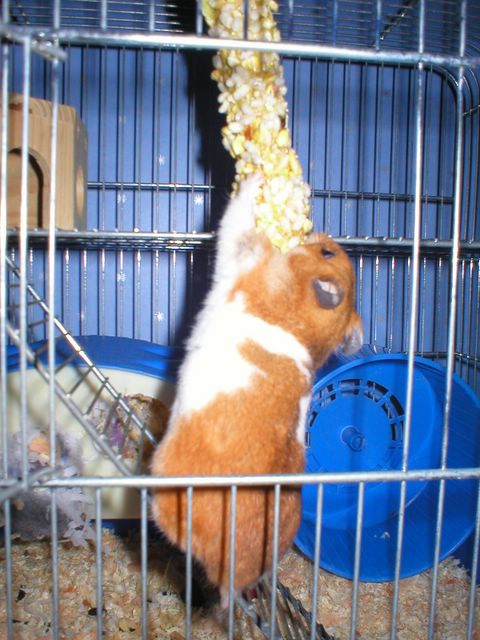
Harry is my little tiny sweet cute hamster.
He has soft, smooth, silky fur,
bright black beady button eyes.
Harry's ears are flat when he's sleepy
and pop up when he's wide awake.
His pink tiny feet tickle my tummy.
His nose whiffles and whiskers quiver.
Jemima
30 April 2005
Primavera
Marvin / Eeyore says: "Okay, so spring has arrived. The garden is shopping-basketed with flowers we can't afford; the birds make a racket at some unearthy time in the morning; the midges make sitting outside in the evening impossible; and people jump around loaded with enthusiasm but short on common-sense. So, whoopee."
I lie. Vivaldi. The lighter mornings and longer evenings make life feel more. The respite from perpetual cold. Fresh salads in the shops - and a desire to eat them (instead of warming soups and stews). The sense of impending opportunity.
Peter.
I lie. Vivaldi. The lighter mornings and longer evenings make life feel more. The respite from perpetual cold. Fresh salads in the shops - and a desire to eat them (instead of warming soups and stews). The sense of impending opportunity.
Peter.
05 March 2005
Let it snow? No way! Where's spring?
Under how many metres of snow have we been buried? Too many. The cold. The leaky shoes. The insecure footing. The risk of skidding, or another vehicle waltzing across traffic lanes out of control. The congested traffic chaos. Not to mention dark nights, dull days and the impossibility of escape. Roll on spring.
Remembering Keukenhof Gardens ablaze with flowering bulbs, and Amsterdam's canals with tree leaf buds bursting green. Remembering Parisian parks and the cherry trees dressed up in their blossoming pink tutus. Remembering Barcelona and the bone-warming Mediterranean spring sunshine.
Peter.
Remembering Keukenhof Gardens ablaze with flowering bulbs, and Amsterdam's canals with tree leaf buds bursting green. Remembering Parisian parks and the cherry trees dressed up in their blossoming pink tutus. Remembering Barcelona and the bone-warming Mediterranean spring sunshine.
Peter.
Subscribe to:
Posts (Atom)